An Eye For Watches

My first memory of watches was a Timex television commercial in the 1950s. In the commercial, a Marlin wristwatch was strapped to an outboard boat motor, and then the boat would take off into the water. At the end of the commercial, they would show that the watch was still running, and the announcer would say the classic line, “Timex, it takes a licking and keeps on ticking.” The first watch I remember wearing was a Timex strapped on a fancy tooled leather band. At twenty-two years old, I thought I was styling and profiling that Western-style band. Looking back, I realized that those early memories illustrate some of the primary reasons we wear watches in the first place. We all want a reliable timepiece that is accurate in all types of weather, and some of us want our watch to look cool and make a statement about our individuality. This article will mainly focus on wrist watches, but it is important to include a few words on their predecessor: pocket watches. The first mention of a timepiece designed to be worn comes in the late fifteenth century. The earliest examples were likely attached to a pendant or chain. By the seventeenth century, watches were designed small enough to be carried in pockets. In these early days, a watch was exclusively a luxury item.

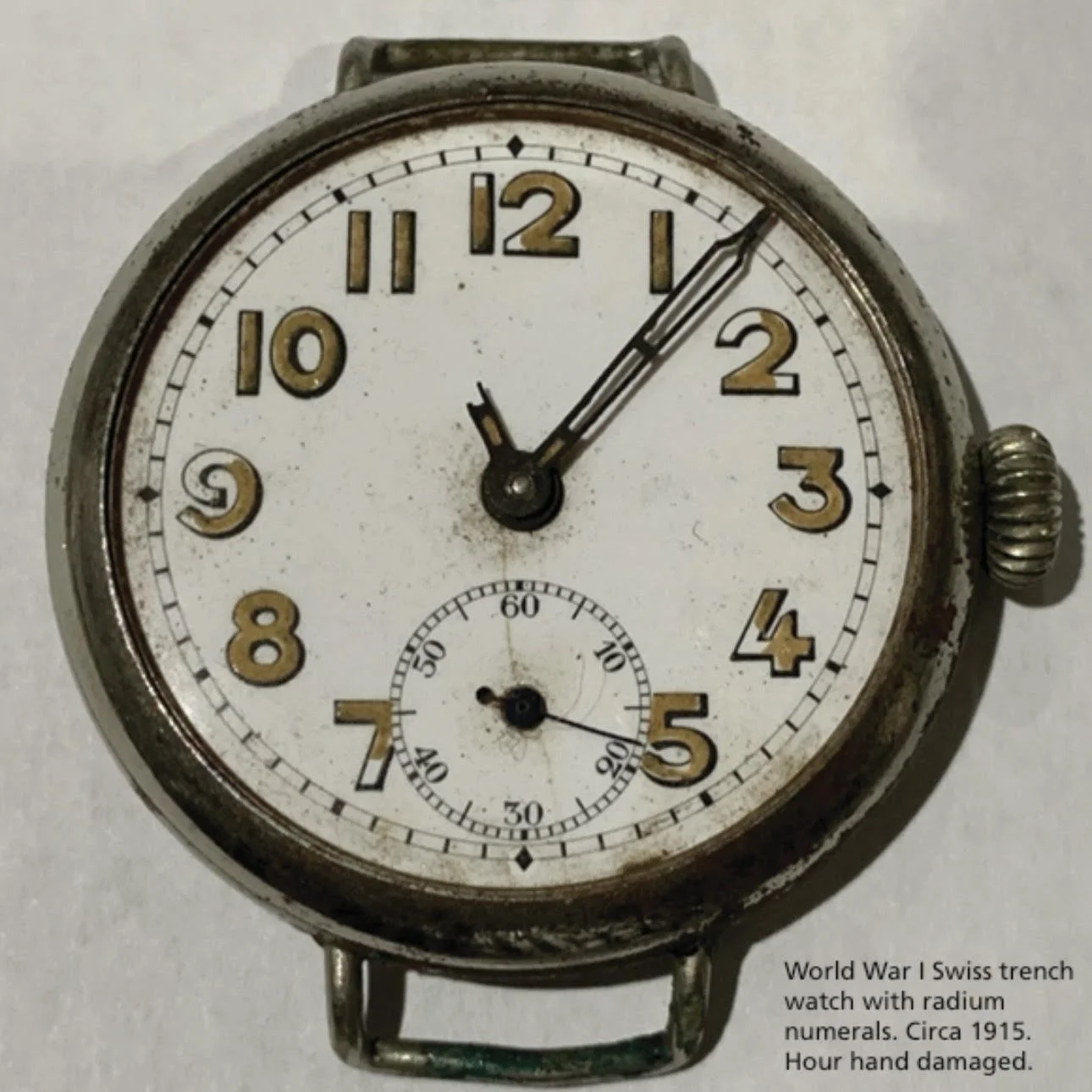
WWI Swiss trench watch with radium numerals. Circa 1915. Hour hand damaged.

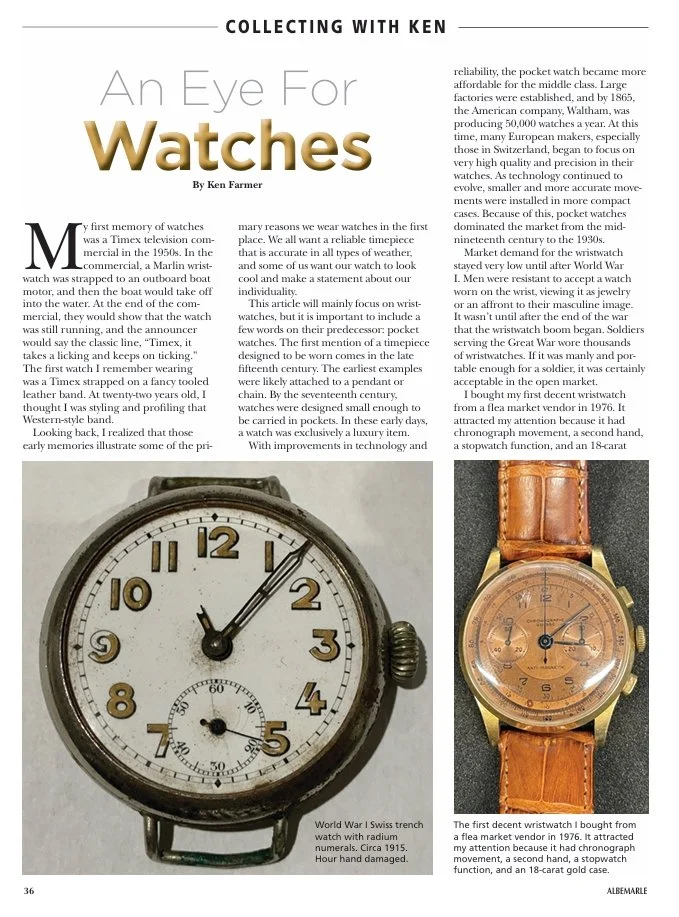
With improvements in technology and reliability, the pocket watch became more affordable for the middle class. Large factories were established, and by 1865, the American company, Waltham, was producing 50,000 watches a year. At this time, many European makers, especially those in Switzerland, began to focus on very high quality and precision in their watches. As technology continued to evolve, smaller and more accurate movements were installed in more compact cases. Because of this, pocket watches dominated the market from the mid nineteenth century to the 1930s. Market demand for the wristwatch stayed very low until after World War I. Men were resistant to accept a watch worn on the wrist, viewing it as jewelry or an affront to their masculine image. It wasn’t until after the end of the war that the wristwatch boom began. Soldiers serving the Great War wore thousands of wristwatches. If it was manly and portable enough for a soldier, it was certainly acceptable in the open market. I bought my first decent wristwatch from a flea market vendor in 1976. It attracted my attention because it had chronograph movement, a second hand, a stopwatch function, and an 18-carat gold case. I took it to a local jeweler in Radford, VA, who cleaned it, put on a new crystal, and sold me a new band. The learning curve was steep from that point forward. I found that some watches had wind-up movements like mine, and higher-priced models had automatic movements, self-winding with any wrist and arm movement. I also learned that there were more complicated movements with alarms, multiple chimes, and additional dials for lots of daily, weekly, and scientific uses. A circa 1914 Patek Philippe pocket watch appraised on Antiques Roadshow in St. Paul, MN, in 2004 was the most complicated watch I’ve ever seen. It has an 18-carat case with chronographic movement, a minute register, chimes, and, on the back, the day, date, month, and a permanent calendar that even adjusts for leap year. The watch presents with the original papers and box, plus an extra crystal and two extra main springs. The movement has 28 jewels. The initial appraisal was $250,000, but the watch sold for over $1.5 million two years later! A more recent PBS Antiques Roadshow airing of this item placed its current value at 2 to 3 million dollars.