An Eye For Watches

My first memory of watches was a Timex television commercial in the 1950s. In the commercial, a Marlin wristwatch was strapped to an outboard boat motor, and then the boat would take off into the water. At the end of the commercial, they would show that the watch was still running, and the announcer would say the classic line, “Timex, it takes a licking and keeps on ticking.” The first watch I remember wearing was a Timex strapped on a fancy tooled leather band. At twenty-two years old, I thought I was styling and profiling that Western-style band. Looking back, I realized that those early memories illustrate some of the primary reasons we wear watches in the first place. We all want a reliable timepiece that is accurate in all types of weather, and some of us want our watch to look cool and make a statement about our individuality. This article will mainly focus on wrist watches, but it is important to include a few words on their predecessor: pocket watches. The first mention of a timepiece designed to be worn comes in the late fifteenth century. The earliest examples were likely attached to a pendant or chain. By the seventeenth century, watches were designed small enough to be carried in pockets. In these early days, a watch was exclusively a luxury item.
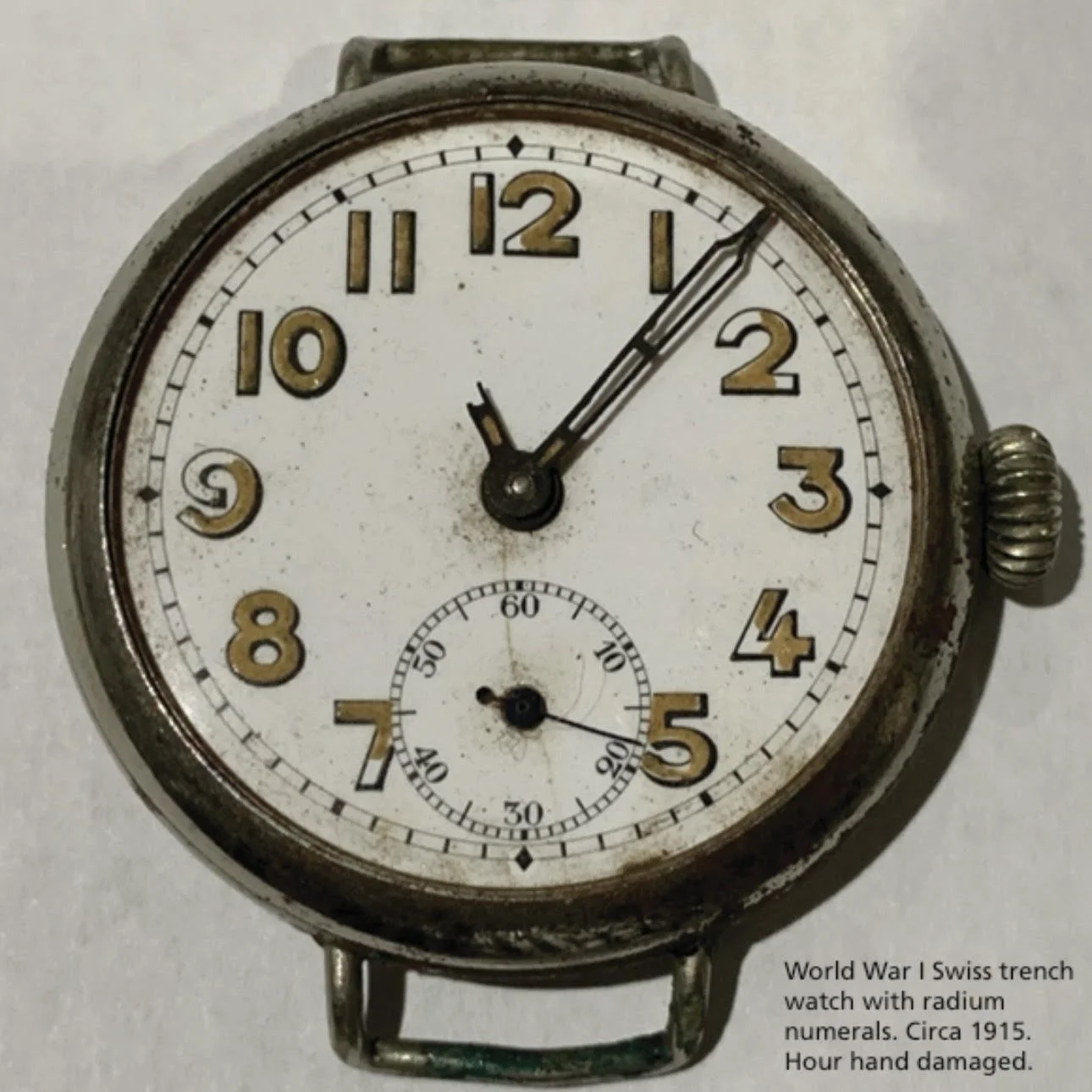
WWI Swiss trench watch with radium numerals. Circa 1915. Hour hand damaged.

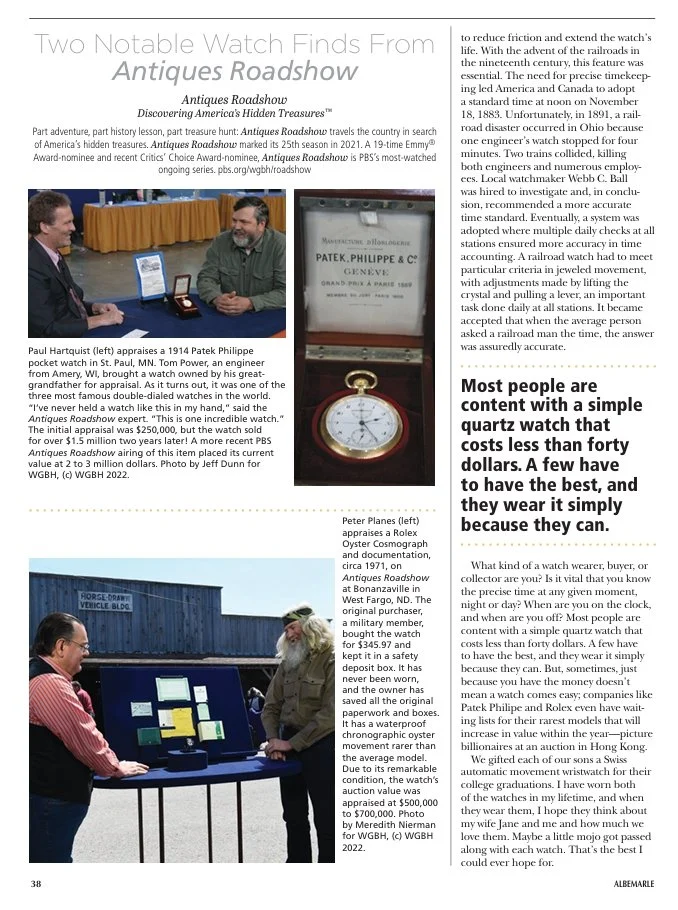
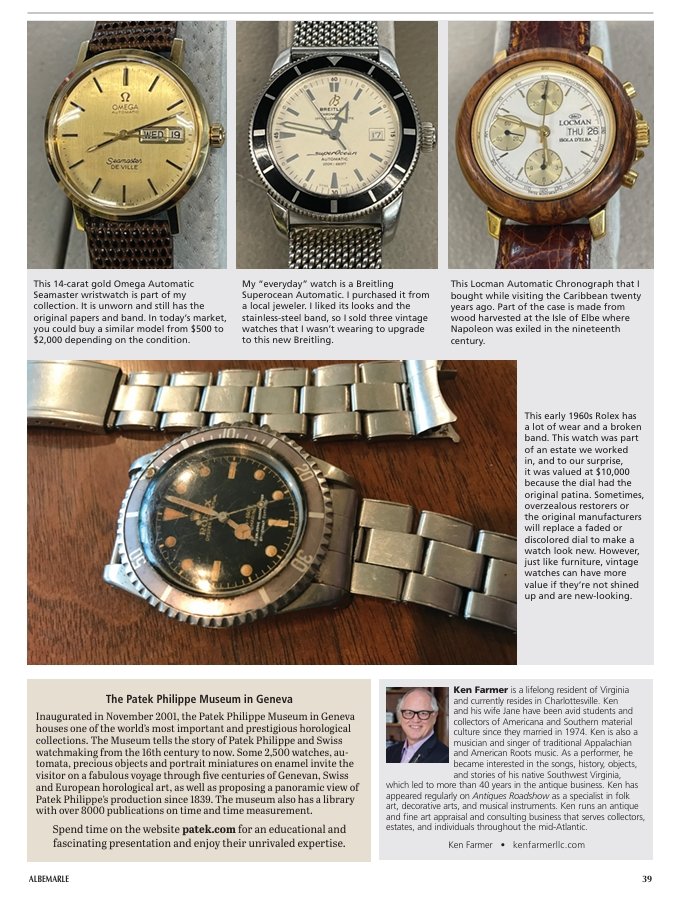
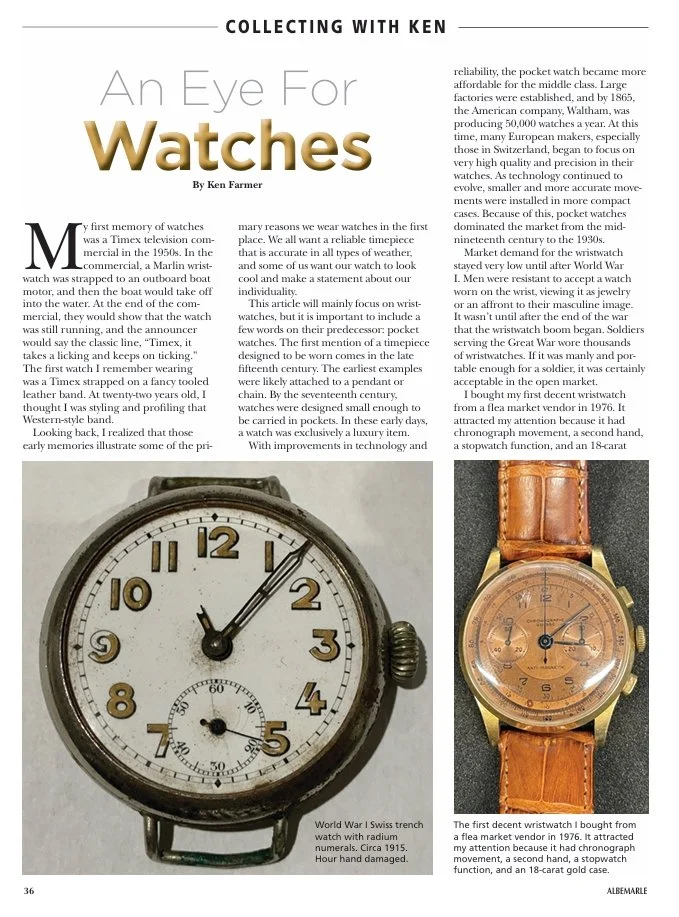
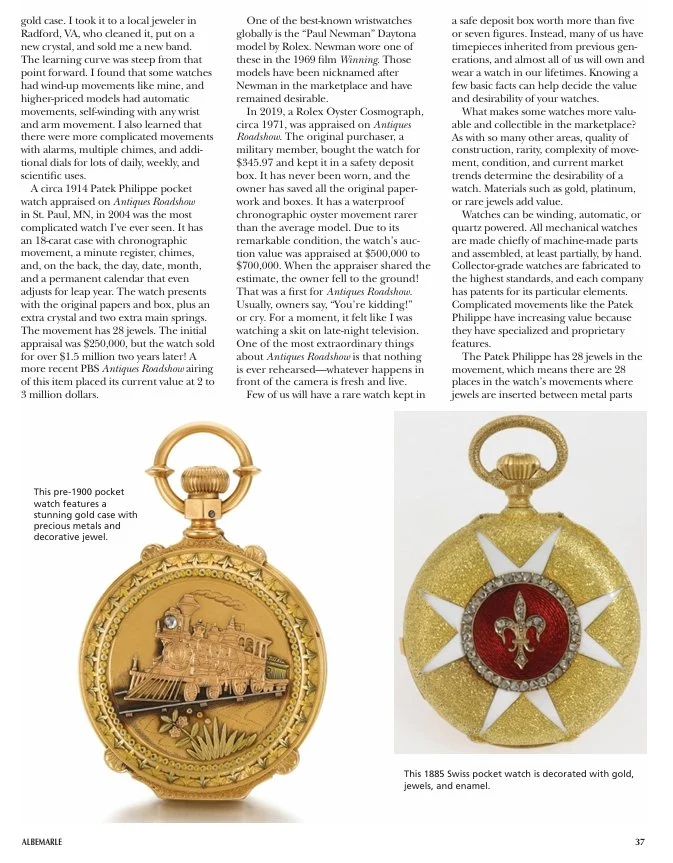
With improvements in technology and reliability, the pocket watch became more affordable for the middle class. Large factories were established, and by 1865, the American company, Waltham, was producing 50,000 watches a year. At this time, many European makers, especially those in Switzerland, began to focus on very high quality and precision in their watches. As technology continued to evolve, smaller and more accurate movements were installed in more compact cases. Because of this, pocket watches dominated the market from the mid nineteenth century to the 1930s. Market demand for the wristwatch stayed very low until after World War I. Men were resistant to accept a watch worn on the wrist, viewing it as jewelry or an affront to their masculine image. It wasn’t until after the end of the war that the wristwatch boom began. Soldiers serving the Great War wore thousands of wristwatches. If it was manly and portable enough for a soldier, it was certainly acceptable in the open market. I bought my first decent wristwatch from a flea market vendor in 1976. It attracted my attention because it had chronograph movement, a second hand, a stopwatch function, and an 18-carat gold case. I took it to a local jeweler in Radford, VA, who cleaned it, put on a new crystal, and sold me a new band. The learning curve was steep from that point forward. I found that some watches had wind-up movements like mine, and higher-priced models had automatic movements, self-winding with any wrist and arm movement. I also learned that there were more complicated movements with alarms, multiple chimes, and additional dials for lots of daily, weekly, and scientific uses. A circa 1914 Patek Philippe pocket watch appraised on Antiques Roadshow in St. Paul, MN, in 2004 was the most complicated watch I’ve ever seen. It has an 18-carat case with chronographic movement, a minute register, chimes, and, on the back, the day, date, month, and a permanent calendar that even adjusts for leap year. The watch presents with the original papers and box, plus an extra crystal and two extra main springs. The movement has 28 jewels. The initial appraisal was $250,000, but the watch sold for over $1.5 million two years later! A more recent PBS Antiques Roadshow airing of this item placed its current value at 2 to 3 million dollars.
COLLECTING WITH KEN: The Pie Safe by Ken Farmer

COLLECTING WITH KEN: The Pie Safe by Ken Farmer

What is a pie safe and where did the term actually come from? Most scholars will agree that it refers to a cupboard with doors used for storage of perishables to protect them from mice and vermin.

Early American use of pie safes is attributed to Germanic immigrants in Pennsylvania, but there were many forms of pie safes made throughout America.

We commonly expect pie safes, or food safes, to have punched tin panels with decorative designs. But they come in all varieties—tall, wide, corner cupboards, sideboards, finely-made, crudely-made, and factory-produced by the end of the nineteenth century. By 1890, prefabricated punched-tin panels were even available for purchase in hardware stores. A lot of people believe that punched tins were used for ventilation, helping to cool a pie for instance, but I believe that punched tins were part of the construction because they also appealed to people and made for a strong decorative selling point.

So now that we know what makes something a pie safe, what makes it a great pie safe? I’ve seen many pie safes throughout my career and in my mind a great safe has a well-made case with nice proportions, an old varnish or painted surface, and, most importantly, deeply punched tins with bold designs that create an artistic effect. Pie safes can be very simple but there are makers who took their designs to a whole other level creating beautiful objects.

Read More

COLLECTING WITH KEN: Patriotic Antiques by Ken Farmer

COLLECTING WITH KEN: Patriotic Antiques by Ken Farmer

Americans love patriotic-themed antiques, primarily when the objects feature iconic images from our past: flags such as Old Glory and her variants, eagles, shields, Lady Liberty, Uncle Sam, and soldiers. George Washington, Thomas Jefferson, Ben Franklin, Abraham Lincoln, and the Centennial and Bicentennial are also popular themes.
How many of us have been to Colonial Williamsburg as children and come home with a tricorn hat or a wooden practice musket? Maybe we went to Philadelphia and got a Liberty Bell paperweight or a small American flag.
The great thing about patriotic antiques is the vast range of quantity and quality that is available. Everything from an inexpensive 1950s vintage desk flag to an original document signed by Washington that is worth six figures are patriotic antiques sought after by the collector.
As you set out in the market, you will find that historical items from the eighteenth and nineteenth centuries can be expensive. When you collect, be aware that anything valuable is worth faking.
Document, textile, and furniture fakes are readily available. If it is too good to be true, it likely is just that. Make sure to buy from reputable sellers and get a provenance or letter of authenticity, if possible.
My favorite patriotic pieces are folk art with brilliant color and exceptional detail. These characteristics can undoubtedly be found on canvas or paper but are especially visible in statuary and other three-dimensional pieces, such as those you can see in the collection of items shown here.

Read More

COLLECTING WITH KEN: Fine Early Baskets

COLLECTING WITH KEN:  Fine Early Baskets

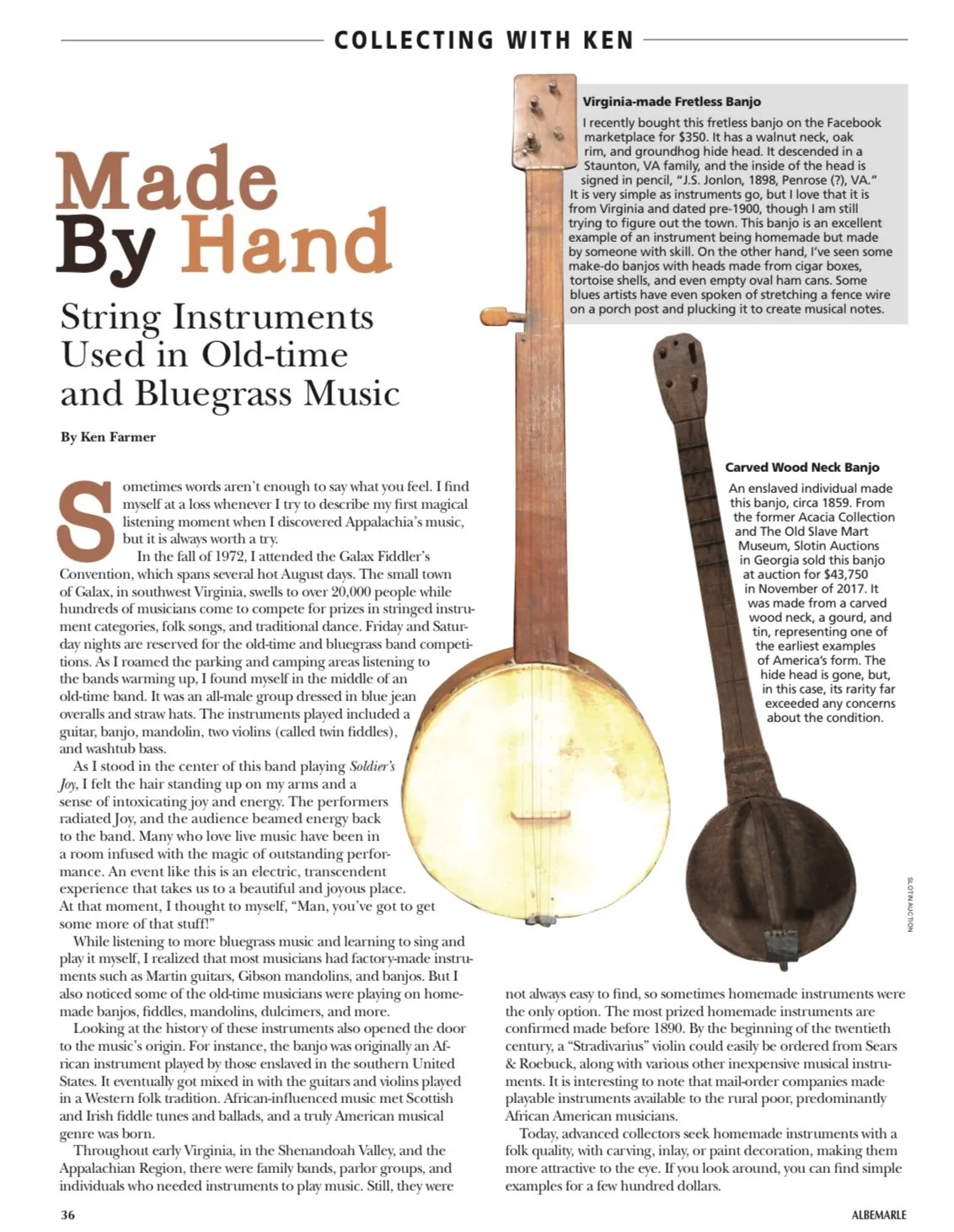
When Jane and I married in 1974, we learned early on that we loved the traditional music, arts, and crafts of the Appalachians. One of our favorite shops to browse in was The Cave House in Abingdon, VA. They sold locally produced items by artisans and craftspeople who followed traditional techniques, while also putting their interpretation on the objects they created. There was everything from batiks, musical instruments, and furniture, to carvings, paintings on barn wood, and more. The first things that caught our eye at the Cave House were baskets made from white oak splints by a woman everyone called “Miss Mary.”

Read More